
Introduction: Why Financial Reporting Still Slows Down Businesses Financial reporting is one of the most important outputs of any business.
Introduction: Why Financial Reporting Still Slows Down Businesses
Financial reporting is one of the most important outputs of any business.
It tells you:
-
How much you earned
-
What you spent
-
Where you stand financially
It drives:
-
Strategic decisions
-
Investor communication
-
Compliance reporting
Yet, despite its importance, financial reporting remains one of the slowest and most manual processes in many organizations.
Finance teams spend days — sometimes weeks — preparing reports.
They:
-
Collect data from multiple systems
-
Reconcile inconsistencies
-
Adjust entries
-
Validate numbers
And even after all this effort, the reports often reflect the past — not the present.
In a fast-moving business environment, delayed reporting is a major disadvantage.
The Traditional Reporting Process: Where Time is Lost
Let’s look at how financial reporting typically works.
Step 1: Data Collection
Data is pulled from:
-
Accounting systems
-
Payroll tools
-
Expense platforms
-
Spreadsheets
Step 2: Data Consolidation
Finance teams:
-
Combine data manually
-
Align formats
-
Resolve mismatches
Step 3: Reconciliation
Transactions are:
-
Verified
-
Adjusted
-
Corrected
Step 4: Report Preparation
Reports are created:
-
In Excel
-
Using templates
Step 5: Validation
Reports are reviewed multiple times.
Each step adds time, effort, and risk.
The Core Problem: Reporting is Manual and Reactive
The biggest issue is not the effort — it’s the approach.
Traditional reporting is:
-
Manual
-
Periodic
-
Backward-looking
By the time reports are ready:
The business has already moved forward.
Why Manual Reporting Fails Modern Businesses
1. Delayed Insights
Reports are available only after:
-
Data collection
-
Processing
-
Validation
Decisions are delayed.
2. High Risk of Errors
Manual processes increase:
-
Data inconsistencies
-
Calculation mistakes
-
Formatting issues
Accuracy becomes a concern.
3. Lack of Real-Time Visibility
Businesses cannot:
-
Track performance continuously
-
Identify issues early
They operate reactively.
4. Heavy Dependency on Finance Teams
Reporting depends on:
-
Skilled resources
-
Time availability
Scaling becomes difficult.
5. Limited Strategic Value
Finance teams spend more time:
-
Preparing reports
Instead of:
-
Analyzing them
Strategic value is reduced.
What is Financial Reporting Automation?
Financial reporting automation uses technology and AI to:
-
Generate reports automatically
-
Update data in real time
-
Eliminate manual effort
Instead of preparing reports manually:
The system generates them continuously.
How AI Transforms Financial Reporting
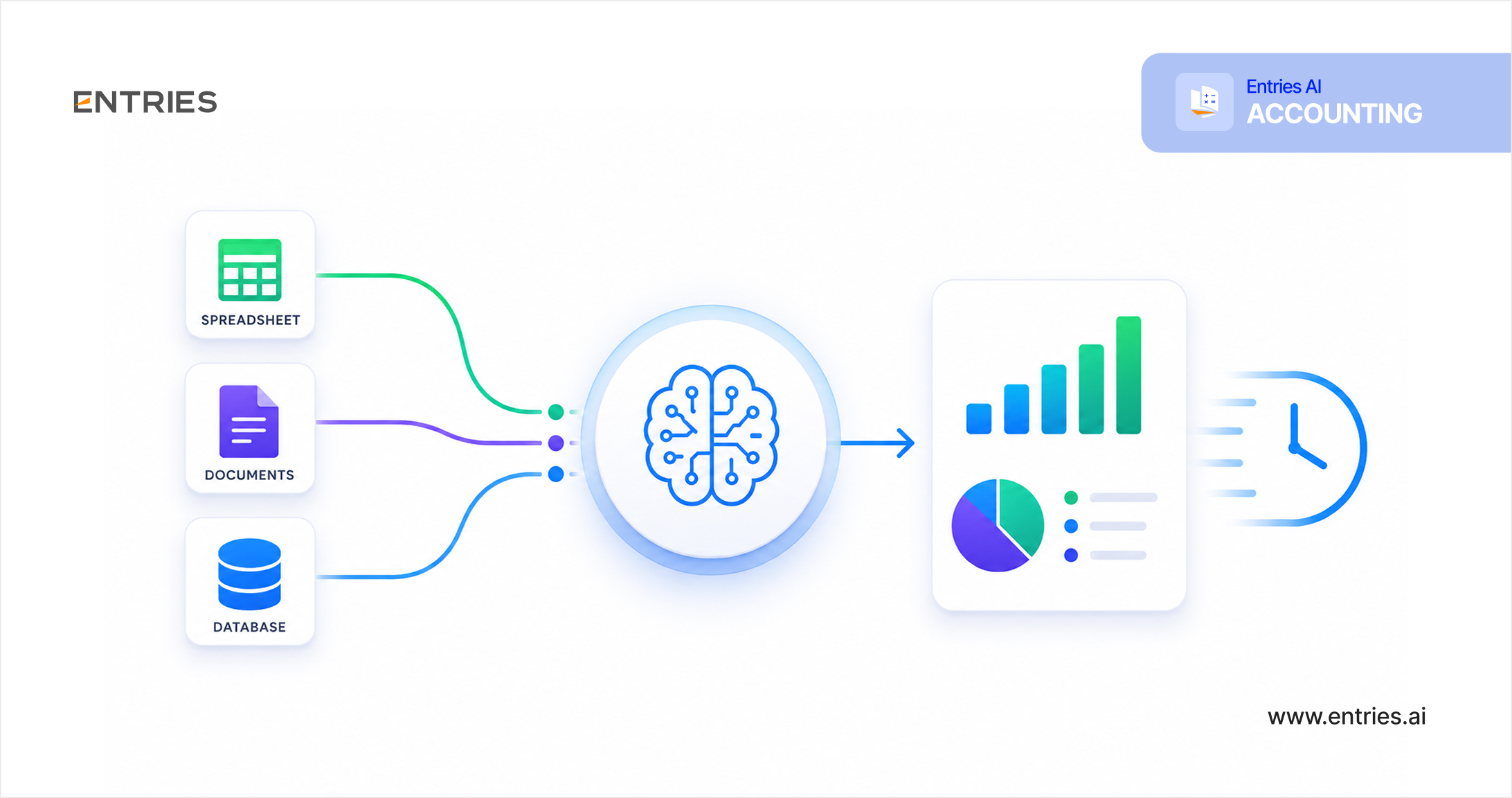
Financial reporting automation
1. Automated Data Flow
AI ensures:
-
Transactions are captured instantly
-
Data flows across systems
No need for manual data collection.
2. Real-Time Report Generation
Reports are:
-
Generated automatically
-
Updated continuously
Always reflect current data.
3. Intelligent Reconciliation
AI:
-
Matches transactions
-
Identifies discrepancies
Reduces manual validation.
4. Dynamic Dashboards
Instead of static reports:
-
Businesses get live dashboards
Insights are always available.
5. Customizable Reporting
AI allows:
-
Flexible report formats
-
Drill-down capabilities
Better analysis and understanding.
From Static Reports to Live Insights
The shift is fundamental.
Traditional reporting:
-
Static
-
Periodic
-
Manual
AI-driven reporting:
-
Dynamic
-
Real-time
-
Automated
Reporting becomes a continuous process.
Why Automation Alone is Not Enough
Even with reporting tools, businesses face challenges.
1. Data Quality Issues
Reports depend on:
-
Accurate data
-
Consistent inputs
2. Process Gaps
Without proper workflows:
-
Data may be incomplete
-
Reports may be unreliable
3. Execution Challenges
Automation needs:
-
Monitoring
-
Validation
-
Oversight
This is where MSP adds value.
Entriesone: Financial Reporting Automation That Works
Entriesone combines:
1. AI-Native ERP Platform (Entries AI)
All financial data is captured in:
One unified system
Includes:
-
Accounting
-
Payroll
-
Compliance
Eliminates data silos.
2. Real-Time Data Processing
Every transaction:
-
Updates instantly
-
Reflects across reports
Reports are always current.
3. Automated Reporting
Financial statements:
-
Generated automatically
-
Available instantly
No manual preparation required.
4. Managed Services Layer
A team ensures:
-
Data accuracy
-
Process consistency
-
Reliable outputs
Guarantees trust in reports.
5. CFO-Ready Dashboards
Leadership gets:
-
Financial insights
-
Business metrics
-
Decision-ready data
One place of truth.
Real-World Comparison: Before vs After
Before (Manual Reporting)
-
Data collected from multiple sources
-
Reports prepared in Excel
-
Delayed availability
-
Frequent errors
After (Entriesone AI Reporting)
-
Unified data
-
Automated reports
-
Real-time insights
-
High accuracy
The difference is speed and reliability.
Business Impact of Reporting Automation
1. Faster Decision-Making
Real-time insights enable quick actions.
2. Improved Accuracy
Automation reduces errors.
3. Increased Efficiency
Less time spent on reporting.
4. Better Strategic Focus
Finance teams focus on insights, not preparation.
5. Scalability
Reporting handles growth effortlessly.
Who Needs Financial Reporting Automation?
This is critical for:
-
Startups scaling rapidly
-
SMBs managing complexity
-
CFOs and finance leaders
-
Multi-entity businesses
If reporting takes too long, automation is essential.
The Future: Real-Time, Always-On Reporting
The future of financial reporting is:
-
Automated
-
Real-time
-
Insight-driven
Businesses will:
-
Stop preparing reports
-
Start consuming insights
Reporting becomes a continuous flow.
Conclusion: From Reporting Delays to Instant Insights
With AI-powered automation:
-
Reports are instant
-
Data is accurate
-
Insights are real-time
The shift is simple:
From:
Manual reporting
To:
Automated, real-time insights
Still spending days preparing financial reports?
It’s time to automate and accelerate
Your AI-powered partner for accounting, payroll, compliance, and reporting.
Run your business with a connected view.
Explore accounting, HRMS, inventory and compliance in one platform.
Book a free demo ↗