
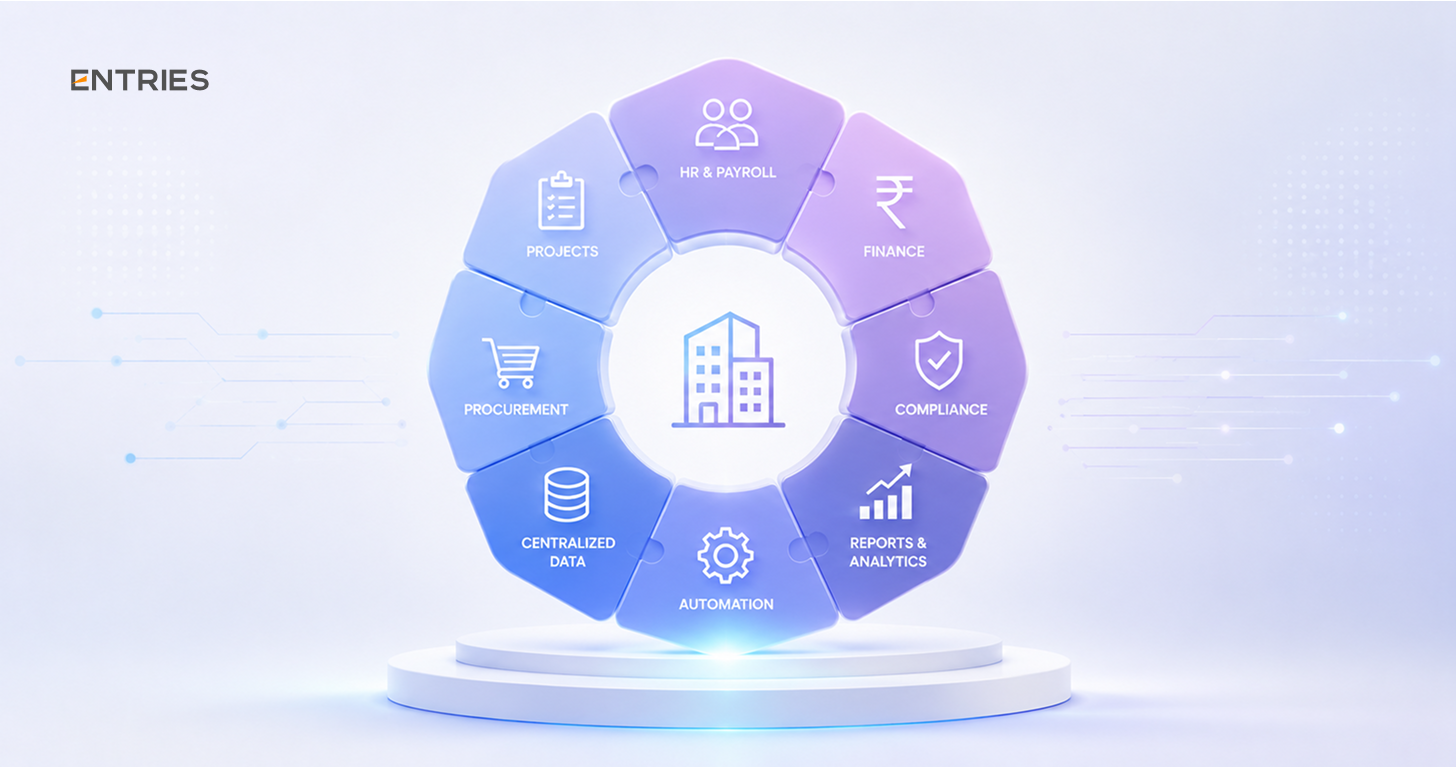
The Modern Business Software Problem Most growing businesses do not start with a unified ERP system.
The Modern Business Software Problem
Most growing businesses do not start with a unified ERP system.
Instead, they gradually adopt multiple applications for different departments:
- HRMS software
- Payroll software
- Accounting software
- CRM systems
- Expense management tools
- Attendance applications
- Compliance software
- Inventory systems
- Project management tools
- Recruitment platforms
Initially, this appears manageable.
But as organizations scale, disconnected applications create significant operational complexity.
Teams begin struggling with:
- Duplicate data entry
- Data inconsistencies
- Reporting gaps
- Manual coordination
- Delayed approvals
- Compliance risks
- Workflow inefficiencies
- Lack of business visibility
This is why growing companies are rapidly moving toward unified AI-native ERP platforms.
What Is a Unified ERP Platform?
A unified ERP (Enterprise Resource Planning) platform connects multiple business operations through one integrated system.
Instead of using separate applications for each function, businesses can manage:
- HRMS
- Payroll
- Accounting
- Compliance
- Inventory
- Manufacturing
- CRM
- Projects
- Expense claims
- Employee documents
- Workforce operations
through a single connected platform.
Unified ERP platforms eliminate operational silos and improve business visibility.
Why Multiple Apps Create Operational Chaos
Using multiple disconnected applications creates several hidden operational problems.
1. Duplicate Data Entry
The same employee, vendor, customer, or financial data often needs to be entered across multiple systems.
For example:
- Employee information in HRMS
- Payroll records in payroll software
- Reimbursements in expense tools
- Attendance in separate systems
This creates:
- Data duplication
- Human errors
- Operational delays
Unified ERP systems eliminate repetitive data entry.
2. Disconnected Workflows
In disconnected systems:
- HR teams work separately
- Finance teams use different applications
- Operations teams maintain isolated workflows
- Compliance data is scattered
This creates:
- Manual coordination
- Delayed approvals
- Operational bottlenecks
- Poor business visibility
Unified ERP platforms connect workflows across departments.
3. Poor Reporting and Visibility
Businesses using multiple systems often struggle with:
- Consolidated reporting
- Real-time business visibility
- Workforce analytics
- Financial visibility
- Operational insights
Leaders spend significant time combining reports manually.
Unified ERP platforms provide centralized real-time visibility across operations.
4. Compliance Risks
Disconnected systems create compliance gaps across:
- Payroll
- Labour laws
- Taxation
- Employee records
- Inventory tracking
- Financial reporting
Manual coordination increases the risk of:
- Filing delays
- Incorrect records
- Audit challenges
- Payroll mismatches
Unified ERP systems simplify compliance through connected workflows.
5. Poor Employee Experience
Employees often need to use multiple applications for:
- Payslips
- Attendance
- Leave management
- Expense claims
- Approvals
- Documents
This creates a fragmented employee experience.
Unified ERP systems improve employee experience through connected mobile-first workflows.
Why Growing Businesses Are Moving Toward Unified ERP Platforms
Modern businesses require:
- Faster operations
- Real-time visibility
- AI-driven automation
- Connected workflows
- Better employee experience
- Operational scalability
- Compliance automation
Managing all of this through disconnected applications becomes increasingly difficult.
Unified ERP platforms solve this by creating one connected operational system for the organization.
The Shift from Software Tools to Business Operating Platforms
Traditional software applications were designed as standalone tools.
Modern AI-native ERP platforms are evolving into connected business operating systems.
They unify:
- Workforce operations
- Finance
- Compliance
- Inventory
- Manufacturing
- Sales
- Procurement
- Projects
- Reporting
through one platform.
This fundamentally changes how businesses operate.
How AI Is Accelerating the Shift to Unified ERP
AI is playing a major role in the transition from disconnected software stacks to unified ERP platforms.
AI-powered ERP systems can:
- Automate workflows
- Detect anomalies
- Improve approvals
- Simplify compliance
- Automate reporting
- Improve workforce insights
- Reduce manual entries
- Provide conversational access to business operations
This significantly improves operational efficiency.
Why Unified ERP Is Critical for Growing Businesses
Growing businesses face increasing operational complexity.
As teams scale, businesses need:
- Centralized data
- Real-time visibility
- Faster workflows
- Operational automation
- Workforce coordination
- Financial control
- Compliance tracking
Unified ERP platforms provide a scalable operational foundation for business growth.
Key Business Functions That Benefit from Unified ERP
1. HRMS and Payroll
Connected workflows between:
- Attendance
- Payroll
- Reimbursements
- Leaves
- Employee records
- Compliance
improve workforce efficiency significantly.
2. Accounting and Finance
Unified ERP platforms connect:
- Expenses
- Payroll
- Procurement
- Invoicing
- GST
- Financial reporting
through one connected financial system.
3. Compliance Management
Businesses can automate:
- Payroll compliance
- Labour law tracking
- GST workflows
- Employee documentation
- Statutory reporting
through centralized compliance systems.
4. Inventory and Manufacturing
Connected ERP systems improve:
- Inventory visibility
- Procurement workflows
- Production tracking
- Material planning
- Warehouse operations
through integrated operational workflows.
5. CRM and Sales Operations
Unified CRM workflows help businesses manage:
- Leads
- Quotations
- Customer workflows
- Sales pipelines
- Revenue visibility
through one connected system.
Why AI-Native ERP Platforms Are the Future
The future of business software is no longer about standalone applications.
Modern businesses expect:
- One platform
- One source of truth
- AI-driven automation
- Connected operations
- Real-time visibility
- Unified employee experience
- Faster workflows
This is driving rapid adoption of AI-native ERP platforms globally.
Why Entries AI Is Emerging as a Leading Unified ERP Platform
Entries.ai is built as an AI-native unified ERP platform for growing businesses.
Unlike traditional disconnected software stacks, Entries AI unifies:
- HRMS
- Payroll
- Accounting
- Compliance
- ESS Mobile App
- Recruitment & ATS
- Expense claims
- Inventory
- Manufacturing
- CRM
- Projects
- Documents
- Business insights
through one connected AI-powered platform.
How Entries AI Helps Eliminate Multiple App Complexity
Connected Workforce Operations
Manage:
- Payroll
- Attendance
- Leave management
- Employee documents
- Expense claims
- Workforce compliance
through one platform.
Unified Financial Operations
Connect:
- Accounting
- Procurement
- Invoicing
- GST
- Payroll
- Financial reporting
through centralized workflows.
AI-Powered Automation
Automate:
- Payroll validations
- Expense classifications
- Compliance tracking
- Workflow approvals
- Reporting
- Operational insights
through AI-driven workflows.
Real-Time Business Visibility
Get centralized visibility into:
- Workforce operations
- Finance
- Compliance
- Inventory
- Projects
- Business performance
through connected dashboards and analytics.
Benefits of Moving to a Unified ERP Platform
Reduced Operational Complexity
Eliminate disconnected systems and manual coordination.
Better Business Visibility
Get centralized real-time operational insights.
Improved Employee Experience
Provide connected mobile-first workflows for employees.
Faster Workflows
Automate approvals, reporting, and operational processes.
Better Compliance Management
Reduce compliance risks through connected workflows.
Scalable Business Operations
Support business growth through unified automation.
Final Thoughts
The biggest operational bottleneck for growing businesses today is fragmented software.
Multiple disconnected applications create:
- Operational inefficiencies
- Data inconsistencies
- Compliance risks
- Reporting gaps
- Employee frustration
Unified AI-native ERP platforms help organizations simplify operations, automate workflows, and improve business visibility through one connected system.
Platforms like Entries.ai are helping growing businesses transform HR, payroll, finance, compliance, inventory, CRM, and workforce operations through one unified AI-powered ERP platform.
Frequently Asked Questions (FAQs)
What is a unified ERP platform?A unified ERP platform connects multiple business functions such as HRMS, payroll, accounting, inventory, CRM, compliance, and workforce operations through one integrated system. Why do businesses move from multiple apps to ERP?Businesses move to ERP platforms to eliminate duplicate entries, improve visibility, automate workflows, reduce operational complexity, and improve employee experience. What are the benefits of unified ERP software?Unified ERP software improves operational efficiency, reporting visibility, compliance management, employee experience, and business scalability. How does AI improve ERP platforms?AI automates workflows, approvals, validations, reporting, anomaly detection, compliance tracking, and operational insights. Why are AI-native ERP platforms growing rapidly?Businesses increasingly want connected operations, real-time visibility, AI-driven automation, and one source of truth across the organization. |
Looking to Replace Multiple Apps with One Unified ERP Platform?
Explore how Entries.ai helps growing businesses simplify HR, payroll, accounting, compliance, inventory, CRM, and workforce operations through one unified AI-native ERP platform.
Run your business with a connected view.
Explore accounting, HRMS, inventory and compliance in one platform.
Book a free demo ↗