Intro: Introduction: Growth Brings Complexity — Especially in Finance
As businesses grow, expansion often brings structural complexity.
What starts as a single company evolves into:
-
Multiple legal entities
-
Subsidiaries
-
Business units
-
Cross-border operations
This is a natural part of scaling.
But with growth comes a new challenge:
Managing multi-entity accounting and financial consolidation
At first, businesses try to manage each entity independently.
Separate books are maintained. Reports are generated individually. Consolidation is done manually — often in spreadsheets.
But as the number of entities increases, this approach quickly becomes unsustainable.
Finance teams struggle with:
-
Intercompany transactions
-
Data inconsistencies
-
Delayed consolidation
-
Lack of real-time visibility
What worked for one entity breaks down when there are many.
What is Multi-Entity Accounting?
Multi-entity accounting refers to managing financial records across multiple companies or business units within a group.
Each entity may have:
-
Its own books
-
Its own compliance requirements
-
Its own financial statements
But at a group level, businesses also need:
-
Consolidated financial reports
-
Intercompany reconciliation
-
Unified visibility
This dual requirement makes multi-entity accounting complex.
The Real Challenges of Multi-Entity Accounting
1. Disconnected Systems Across Entities
In many organizations, each entity operates on:
-
Separate accounting systems
-
Different processes
Result:
-
Data inconsistency
-
Lack of standardization
2. Manual Intercompany Transactions
Transactions between entities include:
-
Sales
-
Expenses
-
Transfers
Without automation:
-
Entries must be recorded in both entities
-
Reconciliation becomes manual
High risk of mismatches.
3. Delayed Consolidation
Consolidation typically happens:
-
At month-end
-
After all entities submit reports
This involves:
-
Data collection
-
Adjustments
-
Elimination entries
The process is slow and error-prone.
4. Currency and Compliance Differences
For businesses with:
-
Multiple geographies
-
Different tax structures
Challenges increase further:
-
Currency conversion
-
Local compliance requirements
Complexity multiplies.
5. Lack of Real-Time Visibility
Leadership often lacks:
-
A consolidated view of performance
-
Real-time financial insights
Decisions are delayed.
The Hidden Risks of Poor Multi-Entity Management
Multi-entity complexity is not just operational — it has strategic implications.
-
Inaccurate Reporting
Errors in consolidation can distort financial performance.
-
Compliance Risk
Incorrect filings across entities can lead to penalties.
-
Delayed Decision-Making
Without consolidated data, leadership operates in the dark.
-
Increased Operational Cost
Manual processes require larger teams.
Poor multi-entity management slows down growth.
What is Financial Consolidation?
Financial consolidation is the process of combining financial data from multiple entities into a single set of statements.
This includes:
-
Aggregating financial data
-
Eliminating intercompany transactions
-
Standardizing reporting
The goal is to provide a unified view of the business.
Why Traditional Consolidation Methods Fail
Most businesses still rely on:
-
Excel sheets
-
Manual adjustments
-
Offline consolidation
Problems:
-
Time-consuming
-
Error-prone
-
Difficult to scale
Consolidation becomes a bottleneck.
How AI Transforms Multi-Entity Accounting
AI introduces automation and intelligence into the process.
1. Automated Intercompany Accounting
AI systems:
-
Record transactions across entities automatically
-
Ensure both sides are matched
Eliminates manual duplication.
2. Real-Time Consolidation
Instead of waiting for month-end:
-
Data is consolidated continuously
Always have a group-level view.
3. Intelligent Reconciliation
AI:
-
Matches intercompany transactions
-
Flags discrepancies
Faster and more accurate reconciliation.
4. Currency Conversion Automation
AI handles:
-
Exchange rate updates
-
Conversion calculations
Simplifies global operations.
5. Unified Reporting
AI generates:
-
Consolidated financial statements
-
Group-level dashboards
Real-time visibility across entities.
From Fragmentation to Unified Finance
The shift from manual processes to AI-driven systems transforms multi-entity management.
Traditional approach:
-
Separate systems
-
Manual consolidation
AI-driven approach:
-
Unified platform
-
Automated consolidation
Finance becomes:
Integrated, real-time, and scalable
Why Multi-Entity Businesses Need More Than Software
Managing multiple entities is not just about tools.
It requires:
-
Consistent processes
-
Accurate data
-
Continuous oversight
Even with automation:
-
Exceptions need handling
-
Compliance needs monitoring
This is where MSP becomes critical.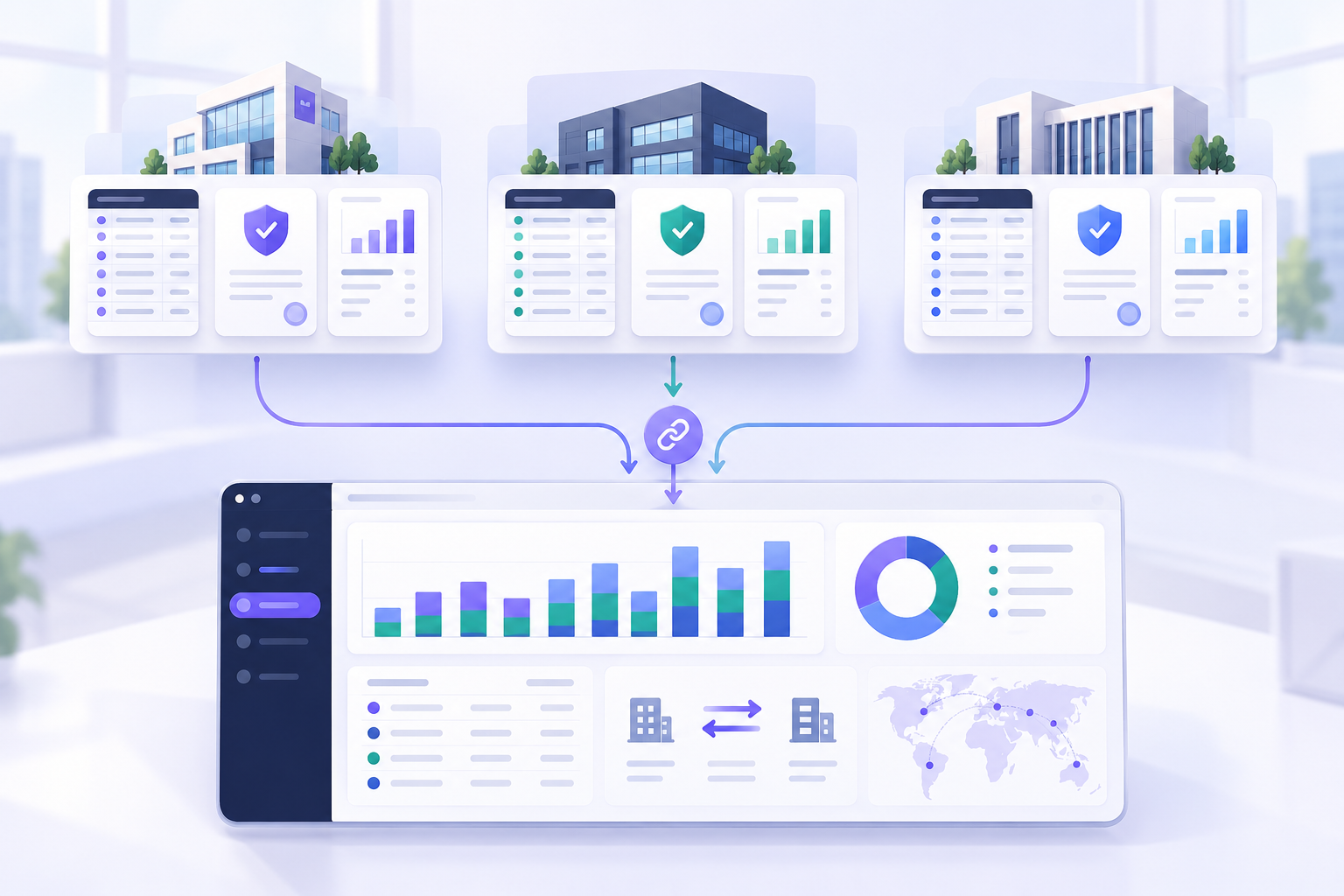
Entriesone: Multi-Entity Accounting Made Simple
Entriesone provides a complete solution for multi-entity businesses.
1. AI-Native ERP Platform (Entries AI)
- All entities operate
- Data is standardized
- One system for the entire group.
2. Automated Intercompany Transactions
- Transactions are mirrored across entities
- Reconciliation is automatic
- No mismatches, no manual effort
3. Real-Time Consolidation
- Aggregated instantly
- Available at group level
- Always know your business performance.
4. Managed Services Layer
- Oversees accounting
- Ensures accuracy
- Handles compliance
- Eliminates operational burden.
5. CFO-Ready Dashboards
- Consolidated insights
- Real-time visibility
- Decision-ready data
- One place for complete business clarity.
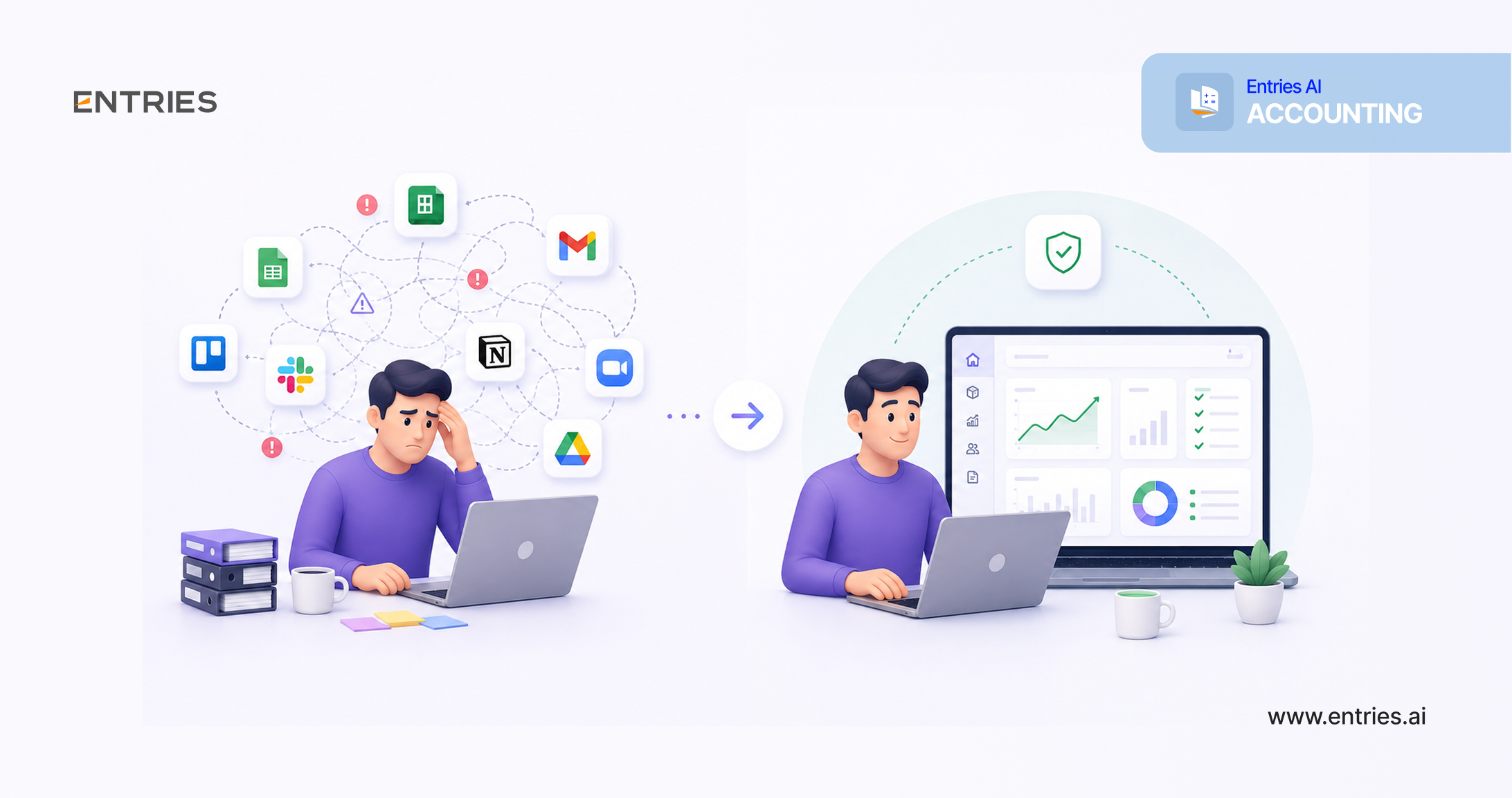
Real-World Transformation: Before vs After
Entriesone provides a complete solution for multi-entity businesses
Before (Traditional Setup)
-
Separate systems for each entity
-
Manual intercompany entries
-
Excel-based consolidation
-
Delayed reporting
After (Entriesone AI + MSP)
-
Unified platform
-
Automated transactions
-
Real-time consolidation
-
Instant reporting
The difference is control and clarity.
Business Impact of AI-Driven Multi-Entity Accounting
-
Faster Consolidation
Reports available in real time.
-
Improved Accuracy
Automation reduces errors.
-
Better Decision-Making
Leadership gets complete visibility.
-
Reduced Operational Effort
Less manual work for teams.
-
Scalability
System handles growth effortlessly.
Who Needs Multi-Entity Accounting Solutions?
This is essential for:
-
Group companies
-
Startups with multiple entities
-
Manufacturing businesses
-
Global operations
If you manage more than one entity, you need a unified approach.
The Future: Real-Time, Automated Consolidation
The future of multi-entity accounting is:
-
Fully automated
-
Real-time
-
AI-driven
Businesses will:
-
View group performance instantly
-
Make faster decisions
-
Scale without complexity
Manual consolidation will become obsolete.
Conclusion: Simplify Complexity with the Right System
Multi-entity accounting doesn’t have to be complex.
With the right system:
-
Data is unified
-
Processes are automated
-
Insights are instant
The goal is simple:
From fragmented entities to one unified financial view
Still managing multiple entities with spreadsheets and manual consolidation?
It’s time to simplify and scale
Your AI-powered partner for accounting, payroll, and compliance.

Nagendra Raju
Co-founder of Entries.AI, leading the charge in building a unified business application that simplifies how SMBs operate today. Instead of juggling multiple-point solutions, SMBs can now rely on a single, seamless system that connects their entire workforce, operations, accounting, and finance functions.