
Introduction: Accounting is No Longer What It Used to Be
For decades, accounting and bookkeeping have been defined by:
-
Manual data entry
-
Spreadsheet tracking
-
Periodic reporting
-
Heavy human dependency
It was slow.
It was error-prone.
And it required significant effort to maintain accuracy.
But today, something fundamental has changed.
Artificial Intelligence (AI) is not just improving accounting —
It is redefining how finance operations work
Businesses are moving from:
-
Manual bookkeeping
to
-
Automated, real-time, AI-driven finance systems
And when combined with Managed Services (MSP), this transformation becomes even more powerful.
The Traditional Accounting Model: Where It Falls Short
Before we understand AI’s impact, let’s look at the traditional model.
1. Manual Data Entry
Every transaction requires:
-
Invoice entry
-
Categorization
-
Ledger posting
Challenges:
-
Time-consuming
-
Prone to errors
-
Not scalable
2. Reconciliation Complexity
Matching:
-
Bank transactions
-
Vendor invoices
-
Payments
Challenges:
-
Manual matching
-
High effort
-
Frequent discrepancies
3. Delayed Reporting
Reports are generated:
-
Weekly
-
Monthly
Problem:
Decisions are based on outdated data
4. Compliance Risk
Tracking:
-
GST filings
-
Tax deadlines
-
Payroll compliance
Issues:
-
Missed deadlines
-
Manual tracking
-
Penalties
The traditional model is:
Reactive, manual, and inefficient
What is AI in Accounting?
AI in accounting refers to:
Using intelligent systems to automate, analyze, and optimize financial processes
Key Capabilities of AI
-
Data extraction
-
Pattern recognition
-
Automated categorization
-
Predictive analytics
AI doesn’t just process data —
It understands and acts on it
How AI is Transforming Accounting & Bookkeeping
1. Automated Invoice Processing
AI can:
-
Scan invoices
-
Extract data
-
Categorize transactions
Before AI:
-
Manual entry
-
Time-consuming
After AI:
-
Instant processing
-
Minimal human intervention
Result: Faster and error-free bookkeeping
2. Intelligent Categorization
AI learns from:
-
Past transactions
-
Patterns
-
Vendor behavior
Benefit:
-
Accurate ledger classification
-
Reduced manual corrections
3. Real-Time Reconciliation
AI automatically:
-
Matches transactions
-
Flags discrepancies
-
Suggests corrections
Impact:
-
Faster closing
-
Reduced errors
Reconciliation becomes continuous, not periodic
4. Automated Financial Reporting
AI generates:
-
Profit & Loss statements
-
Balance sheets
-
Cash flow reports
Advantage:
-
Always up-to-date
-
Available on demand
Reports move from:
Monthly → Real-time
5. Compliance Automation
AI tracks:
-
Deadlines
-
Filings
-
Regulatory requirements
Outcome:
-
No missed deadlines
-
Reduced compliance risk
6. Predictive Insights
AI can:
-
Forecast cash flow
-
Predict expenses
-
Identify trends
Accounting becomes:
Forward-looking, not backward-looking
From Bookkeeping to Intelligent Finance Operations
AI shifts accounting from:
Data entry
⇰ to
Decision support
Traditional Role of Accounting
-
Record transactions
-
Generate reports
AI-Driven Role
-
Analyze trends
-
Predict outcomes
-
Support decisions
Accounting evolves into:
Strategic finance function
Why AI Tools Alone Are Not Enough
Here’s a critical insight most businesses miss:
Buying AI tools does NOT solve accounting challenges
Why?
1. Execution Still Matters
-
Systems need to be managed
-
Processes need discipline
2. Data Quality is Critical
AI depends on:
-
Clean data
-
Structured workflows
3. Expertise is Required
Even with AI:
-
Decisions require human judgment
-
Compliance requires oversight
This is where MSP comes in
AI + MSP: The Complete Finance Model
The real transformation happens when AI is combined with Managed Services.
Buying AI tools does NOT solve accounting challenges
AI Provides:
-
Automation
-
Speed
-
Accuracy
MSP Provides:
-
Execution
-
Ownership
-
Expertise
Together:
They create a complete finance operating system
Entriesone: AI-Powered Accounting in Action
Entriesone combines:
1. AI-Native ERP (Entries AI)
A unified platform for:
-
Accounting (GL, AR, AP)
-
Payroll & HRMS
-
Compliance
-
Inventory & manufacturing
-
Business insights
2. Managed Services Layer
A team that:
-
Runs bookkeeping
-
Manages reconciliation
-
Ensures compliance
3. Real-Time Insights
Dashboards that provide:
-
Financial health
-
Profitability
-
Cash flow visibility
Result:
Automated accounting + managed execution + real-time insights
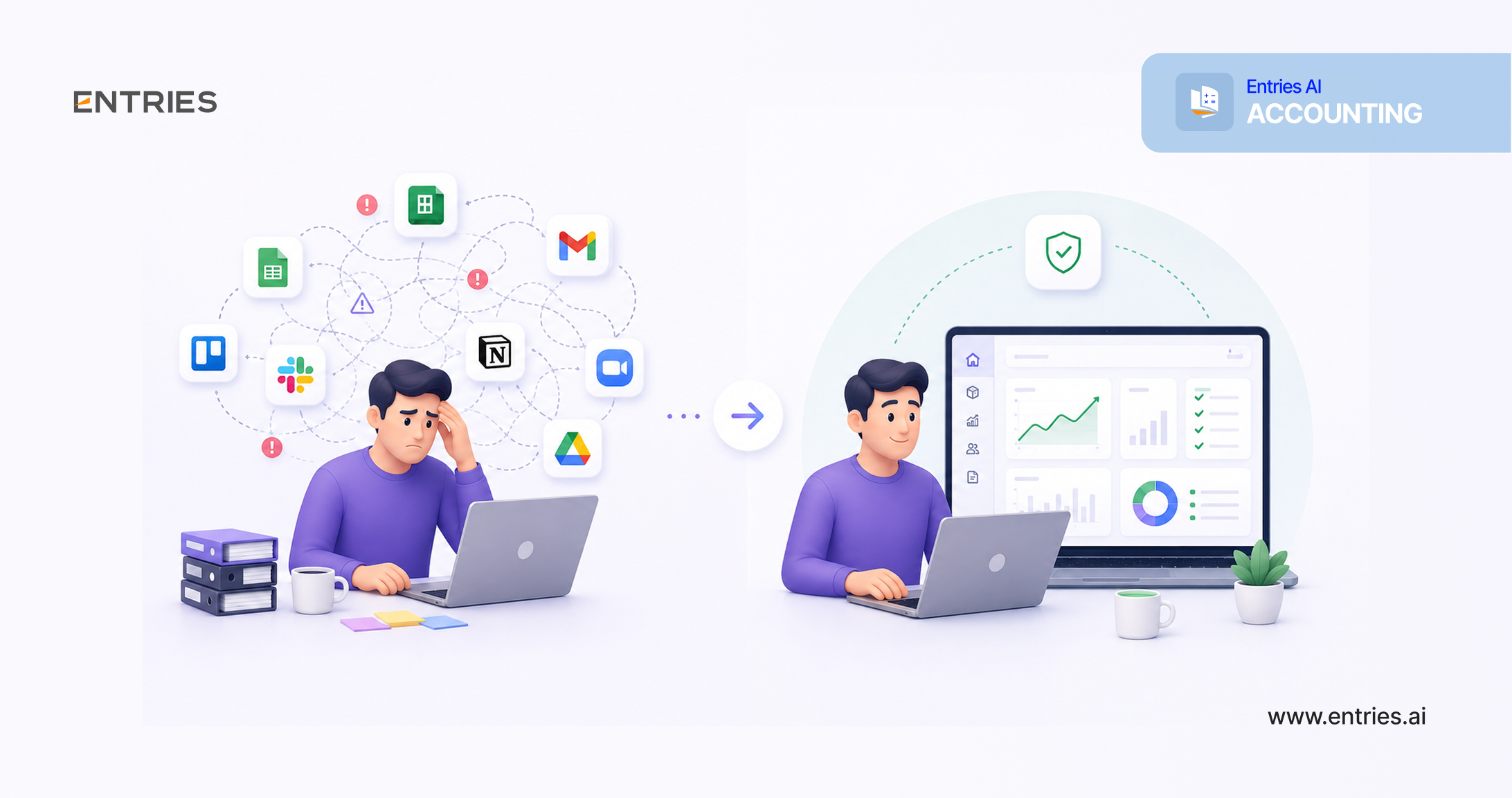
Real-World Example: Before vs After AI
Before AI
-
Manual invoice entry
-
Monthly reconciliation
-
Delayed reporting
-
Compliance tracked manually
After AI + MSP (Entriesone)
-
Automated invoice processing
-
Real-time reconciliation
-
Instant reporting
-
Compliance automated
Outcome:
-
Faster operations
-
Higher accuracy
-
Better decisions
Business Impact of AI Accounting
1. Speed
-
Transactions processed instantly
-
Reports generated in real-time
2. Accuracy
-
Reduced manual errors
-
Better data consistency
3. Cost Efficiency
-
Lower operational cost
-
Reduced manual effort
4. Visibility
-
Real-time dashboards
-
Better decision-making
5. Scalability
-
Handles growing transaction volumes
-
No need for large teams
6. Compliance Confidence
-
Automated tracking
-
Audit-ready systems
Who Benefits the Most from AI Accounting?
Startups
-
Need speed and efficiency
SMBs
-
Managing growth complexity
Manufacturing Companies
-
Require integrated operations
Multi-Entity Businesses
-
Need consolidation and visibility
AI accounting is no longer optional —
It is a necessity
The Future of Accounting
1. Autonomous Finance Systems
AI will handle:
-
Most transactions
-
Most reconciliations
2. Conversational Accounting
Ask:
“What’s my cash flow?”
Get:
Instant answers
3. Predictive Decision-Making
Systems will:
-
Suggest actions
-
Identify risks
Finance becomes:
Real-time, predictive, and intelligent
Conclusion
AI is not just improving accounting —
It is transforming it completely
From:
-
Manual processes
To
-
Intelligent automation
From:
-
Delayed reporting
To
-
Real-time insights
Businesses that adopt AI early will:
-
Operate faster
-
Reduce costs
-
Make better decisions
Still managing accounting manually?
It’s time to upgrade.
Your AI-powered partner for accounting, payroll, and compliance.

Team Entries AI
The Entries AI team writes about accounting, GST, payroll, inventory and compliance for Indian businesses — drawing on what we learn building India's AI-native ERP.